


Sustainability Is No Longer an Option for India’s Heavy Industries -Deepak Mishra, JS, Department of Chemicals & Petrochemicals
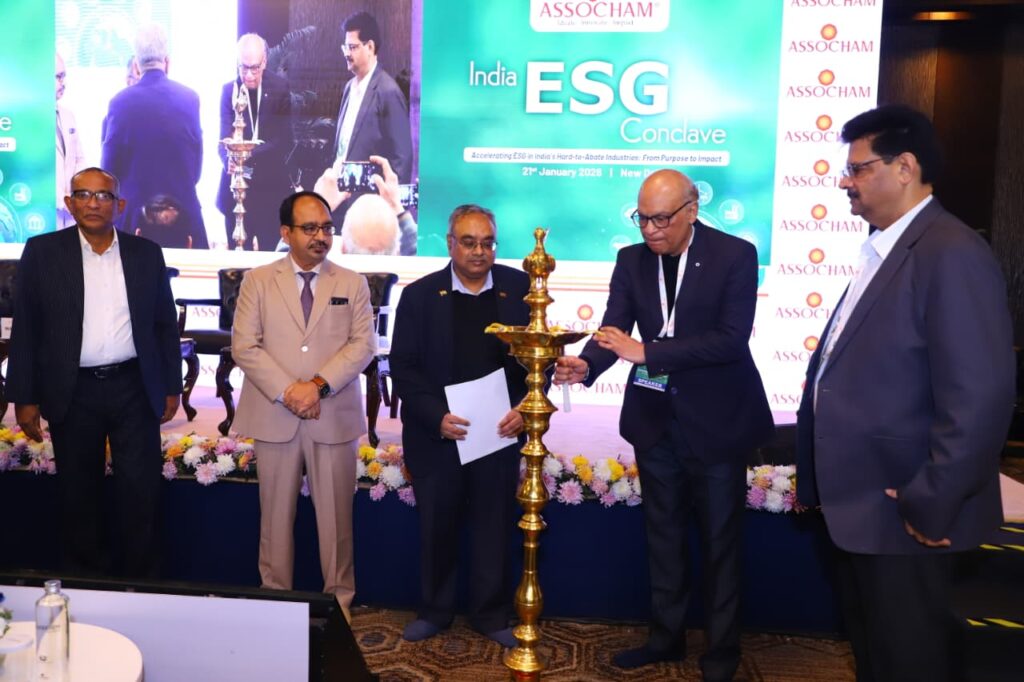
New Delhi, 21 Jan 2025: ASSOCHAM organised the India ESG Conclave “Accelerating ESG in India’s Hard-to-Abate Industries: From Purpose to Impact” at Le Meridian, New Delhi on 21st january. The conference was attended by policymakers, industry leaders, and sustainability experts to deliberate on pragmatic pathways for India’s Net Zero transition.
The conclave focused on integrating ESG across critical sectors, including mining, metals, cement, chemicals, petrochemicals, and hydrocarbons, and highlighting the role of technology. The industry experts also discussed policy support and industry collaboration needed in driving sustainable industrial growth.
During the Conclave, Mr. Deepak Mishra, Joint Secretary (Petrochemicals), Department of Chemicals & Petrochemicals, Govt. of India, said, “While market conditions may fluctuate, India’s commitment to sustainability is firm and irreversible. The government has moved from having an intention to an action plan, setting targets for lowering carbon intensity and focusing on a definite transition to a circular economy. Energy-intensive sectors like petrochemicals and plastic products need to integrate their competitive agenda with their sustainability responsibilities. Extended Producer Responsibility shows that good regulation can provide financial as well as environmental returns, thus encouraging highly efficient recycling systems. In the future, sustainability will move from being a compliance issue to a domain that is defined by innovation, technology, and strategic sustainability initiatives. The organizations that make this transition will not only comply with the regulations but also become important stakeholders in the low-carbon future of the country.”
Mr. Kapil Malhotra, Co-chairman, ASSOCHAM Nation Council on Chemicals & Petrochemicals & Global Business Leader – Fluoropolymers, GFL, Said, ““For hard-to-abate industries such as chemicals and petrochemicals, decarbonisation and the Net Zero pathway are no longer distant ambitions but pressing business priorities. As climate risks intensify, a systems-based approach which combines energy efficiency, cleaner feedstocks, circularity, increased use of renewables and process innovation is becoming essential. ESG must be viewed as a catalyst for transformation rather than a regulatory obligation. With supportive policy frameworks, technology partnerships and collaborative platforms like the India ESG Conclave, Indian industry can significantly accelerate its transition to a low-carbon, globally competitive future.”
Dr. Rambabu Paravastu, Advisor & Chief Sustainability Officer, Greenko Group, Said, “India’s journey towards Net Zero will be defined by how effectively we decarbonise hard-to-abate sectors while ensuring energy security and economic growth. The need of the hour is the scale-up of non-carbon emissions, the use of green hydrogen, as well as storage solution-based models becoming integral in converting heavy industries such as steel, cement, and chemicals to low-carbon ones. Another area of paramount importance is arenas such as the India ESG Conclave, which facilitate collective collaboration between stakeholders such as industries, governments, and tech players, accelerating innovative solutions with demonstrable ESG impacts on our collective drive for leading the energy transition revolution globally.”
Mr. Manoj Kumar Rustagi, Chief Sustainability and Innovation Officer, JSW Cement Ltd., Said, “The next 10 years are going to be focused on Industrial decarbonisation specifically hard-to-abate sectors. The opportunity is immense to look for technological solutions which are local and home-grown, to decarbonise and wake economic sense at the same time.”
The event had three panel discussions putting impetus on low-carbon pathways in mining and metals, circularity in chemicals and petrochemicals, and the net-zero roadmap for the hydrocarbon sector. Senior representatives from ONGC, GAIL, Indian Oil, JSW Energy, and Greenko along with government officials, shared insights on green hydrogen, CCUS, clean fuels, and ESG-aligned policy frameworks.
The major highlight of the conclave was the release of a Knowledge Report, underscoring actionable recommendations to accelerate India’s transition towards a resilient, low-carbon industrial ecosystem.